





































Eco-Friendly Cleaning in 2026: What Actually Works and What’s Greenwashing
Eco-Friendly Cleaning in 2026: What Actually Works and What’s Greenwashing
The word “eco-friendly” has never been used more - or meant less.
In 2026, consumers are surrounded by green labels, leaf icons, and marketing that promises purity and sustainability. Yet research shows many conventional and “natural” cleaning products still contain chemicals that pollute indoor air, irritate the lungs, disrupt hormones, and contribute to long-term environmental waste (Dutta et al., 2021; Nazaroff, 2021).
At Esottera, we believe sustainability begins with clarity, not complexity.
A truly clean home - like a truly aligned life - doesn’t need dozens of brightly labeled bottles. It needs intention, transparency, and ingredients that honor both your body and the Earth.
Here’s what science actually says works in 2026, and what’s simply greenwashing dressed in marketing.
The Hidden Problem: When “Green” Isn’t Green
A 2021 study published in Environmental Science & Technology found that many cleaning products marketed as eco-safe still released volatile organic compounds (VOCs) that negatively affect air quality and respiratory health (Dutta et al., 2021).
Another review highlighted that fragrances - even those labeled “natural” - can produce secondary pollutants indoors, including formaldehyde, when they react with ozone (Nazaroff, 2021).
And products with vague ingredient descriptions (e.g., “proprietary blend,” “biodegradable formula,” “fresh scent”) leave consumers guessing - a common form of greenwashing by omission.
This is why your cleaning routine matters: your home is its own ecosystem, and what you breathe is as important as what you eat.
What to Avoid in 2026
1. Synthetic Fragrances (“parfum”)
Fragrances are among the top indoor air irritants. Many contain phthalates - chemicals linked to hormone disruption and asthma (Steinemann, 2019).
2. Quaternary Ammonium Compounds (Quats)
Common in “antibacterial” products, quats have been shown to cause skin irritation, respiratory issues, and contribute to antimicrobial resistance (Peng et al., 2022).
3. Products With Unclear or Incomplete Ingredient Lists
If you can’t see what’s inside, you can’t evaluate safety.
Transparency = trust.
4. “Miracle” or “Ultra-Concentrated” Claims Without Proof
Marketing language often replaces real testing. Look for certifications, data, or third-party assessments - not vague promises.
What Truly Sustainable Cleaning Looks Like
Sustainability isn’t about owning more “eco” products - it’s about owning less and choosing tools that support circularity and clarity.
1. One or Two Multifunctional Cleaners
A simple, plant-based all-purpose cleaner can replace 4-8 conventional products.
Science shows that minimalist formulas reduce VOC emissions and irritation (Dutta et al., 2021).
2. Refillable Packaging
Refill systems cut plastic waste dramatically. Life-cycle assessments show that refillables reduce carbon emissions by up to 80% compared to single-use bottles (Balde et al., 2020).
3. Dilutable Concentrates
Concentrates ship less water, reduce packaging, and offer long-term savings.
A small bottle can last months - a quiet form of sustainable abundance.
4. Plant-Based Surfactants
Look for surfactants derived from coconut, sugar, or corn.
Studies show they biodegrade faster and produce fewer harmful byproducts than petroleum-based cleaners (Jardim et al., 2021).
5. Microfiber or Reusable Cloths
One microfiber cloth can replace dozens of paper towel rolls.
They reduce waste and clean effectively with minimal product - more impact, less footprint.
6. Avoiding “Antibacterial” Unless Absolutely Needed
Regular soil, dust, and everyday surfaces don’t require disinfectants.
Overuse can disrupt both your home’s biome and your skin’s natural barrier (Ferrer et al., 2020).
The Science: What Actually Makes a Home “Clean”
Research across environmental health and indoor air science shows:
-
Plant-based formulas release fewer irritants and VOCs (Dutta et al., 2021).
-
Dust removal and mechanical cleaning (wiping, microfibers, HEPA vacuuming) reduce pollutants more effectively than harsh chemicals (Nazaroff, 2021).
-
Simple surfactants break down dirt without leaving harmful residues.
-
Fragrance-free formulas significantly lower indoor pollutants and allergy triggers (Steinemann, 2019).
A healthy home is less about “sterilizing”
and more about supporting a balanced indoor environment.
The Esottera Approach: Clean, Clear, and Consciously Designed
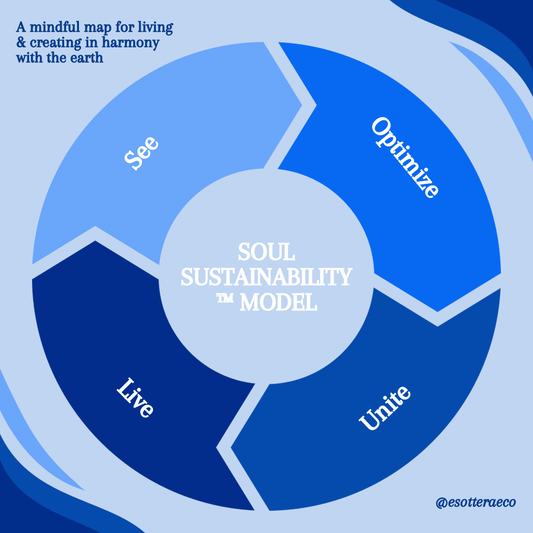
In Esottera’s SOUL™ sustainability model:
-
SEE - You become aware of what’s actually in your cleaners and how they affect your environment.
-
OPTIMIZE - You choose products that reduce waste, toxins, and confusion.
-
UNITE - You strengthen the relationship between your home, your body, and the Earth.
-
LIVE - Your cleaning rituals become an expression of values: clarity, simplicity, and care.
Sustainable cleaning is not about perfection - it’s about presence.
About choosing less, choosing well, and letting your home become a sanctuary of intention.
Cleaning can be clean for you and the planet - without dozens of products.
APA Sources
Balde, C. P., et al. (2020). Life Cycle Assessment of Reusable vs. Single-Use Packaging Systems. United Nations University.
Dutta, M., et al. (2021). Indoor air impacts of household cleaning chemicals. Environmental Science & Technology, 55(18), 12714-12726.
Ferrer, M., et al. (2020). Microbiome interactions in the built environment. Microbiome, 8(1), 15.
Jardim, W. F., et al. (2021). Environmental behavior of surfactants: A review. Environmental Chemistry Letters, 19(6), 4551-4575.
Nazaroff, W. W. (2021). Indoor air chemistry: Cleaning agents, fragrances, and air fresheners. Indoor Air, 31(1), 3-15.
Steinemann, A. (2019). Fragranced consumer products: Effects on indoor air quality and human health. Building and Environment, 158, 140-146.
Peng, Z., et al. (2022). Health and environmental concerns of quaternary ammonium compounds. Environmental Science: Processes & Impacts, 24(2), 192-209.