












































Circular Living 101: How to Create a Regenerative Home in 2026
The Real Meaning of Circular Living (and How to Practice It at Home)
Most people think “circular living” means recycling-but recycling is actually the last step in a circular system. True circularity is a design model that keeps materials in use for as long as possible, lowers resource extraction, and minimizes waste before it’s created.
In a world where 45% of global emissions come from product manufacturing, food systems, and material use (Ellen MacArthur Foundation, 2021), circular living is one of the most effective ways individuals can reduce their environmental impact.
What Circular Living Really Means
Circularity is built on five core principles:
1. Reuse
Extending the life of objects keeps materials in circulation and reduces demand for new production. Reusing an item-even once-can cut its carbon footprint by up to 50% depending on the product category (UNEP, 2020).
2. Repair
Repairing instead of replacing can extend product lifespans by 50-100% (Ellen MacArthur Foundation, 2020). This avoids carbon emissions from manufacturing new goods and reduces the 2.2 billion tons of waste produced globally each year.
3. Minimal Waste
Circular systems aim to eliminate waste at the design level-by making products durable, modular, and multipurpose. For households, this looks like buying fewer, higher-quality items that last longer and perform multiple functions.
4. Long Product Life Cycles
When products are cared for properly and used longer, the environmental burden of extracting raw materials, shipping, and manufacturing is reduced dramatically.
5. Regenerative Sourcing
Circularity prioritizes materials that replenish ecosystems-like bamboo, organic cotton, hemp, biodegradable packaging, and compostable materials. These reduce pollution, soil depletion, and long-term environmental costs.
Circular living is essentially a mindset shift: from disposable to regenerative.
How to Make Your Home More Circular
These practices are simple, low-cost, and backed by environmental research:
1. Repair Before Replacing
Repairing household goods can extend their life 50-100%, drastically cutting emissions and landfill waste (Ellen MacArthur Foundation, 2020).
2. Buy Refillable Goods
Refill systems reduce packaging waste by up to 80% (Green Alliance, 2022) and save money over time.
3. Create a “Use-Up Shelf”
A designated shelf for “open or almost expired” items reduces household food waste-which currently accounts for 8-10% of global emissions (UNEP, 2021).
4. Practice Rotational Decluttering
Instead of large purges that lead to over-donating or trashing items, rotational decluttering keeps your home in a cycle of use, repair, and intentional rotation.
5. Compost Organic Waste
Composting prevents food waste from releasing methane in landfills-methane is 80 times more powerful than CO₂ over 20 years (IPCC, 2021). Even small-scale home composting significantly reduces your waste footprint.
Circular living transforms your home into a regenerative ecosystem, rather than a linear stream of buying → using → discarding.
Circular Living = Soul Sustainability
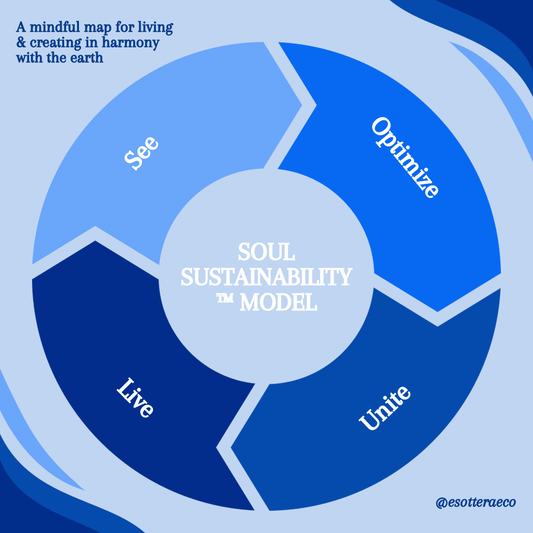
Circular living aligns directly with the OPTIMIZE phase of the SOUL™ Model™.
It focuses on upgrading habits, reducing unnecessary waste, and shifting toward a lifestyle that supports both personal clarity and planetary restoration.
It’s not about perfection.
It’s about flow, resourcefulness, and choosing circularity over disposal.
APA Sources
Ellen MacArthur Foundation. (2020). The circular economy in action.
Ellen MacArthur Foundation. (2021). Completing the Picture: How the Circular Economy Tackles Climate Change.
Green Alliance. (2022). Refill and Reuse Systems Report.
IPCC. (2021). Sixth Assessment Report.
United Nations Environment Programme. (2020). Resource Efficiency & Circularity.
United Nations Environment Programme. (2021). Food Waste Index Report.