















































Regenerative Living: Beyond Sustainability to Renewal
Sustainability often focuses on reducing harm: lowering emissions, minimizing waste, conserving water, and consuming responsibly. While these actions are essential, they are reactive - they stop damage but rarely create renewal. Regenerative living, on the other hand, is proactive: it seeks to restore, renew, and replenish ecosystems while aligning with human inner ecology.
At Esottera, regenerative living is an element of Soul Sustainability™: a practice where external ecological restoration mirrors internal restoration, creating synergy between our personal well-being and the health of the planet.
Sustainability vs. Regeneration
Traditional sustainability asks: “How do we reduce harm?”
Regeneration asks: “How do we give back?”
A sustainable farm reduces chemical inputs.
A regenerative farm restores soil biodiversity, increases carbon capture, and supports ecosystems.
Similarly, in our personal lives:
-
Sustainable living might limit plastic use.
-
Regenerative living intentionally fosters abundance, creativity, and flow.
The difference is proactive contribution vs. harm reduction. Regenerative living aligns inner ecology with outer ecology, creating a feedback loop of renewal.
The Science of Regeneration
1. Soil and Carbon Capture
Regenerative agriculture practices - cover cropping, composting, minimal tillage - enhance soil health and sequester carbon. According to the Rodale Institute (2014), regenerative farming practices can sequester up to 3 - 5 tons of CO₂ per hectare annually, effectively reversing emissions rather than simply reducing them.
This illustrates the principle: restorative practices have multiplicative benefits.
2. Biodiversity
Regeneration encourages species richness and ecological complexity. Biodiverse ecosystems are more resilient, store more carbon, filter water naturally, and maintain healthy food webs. Applying this concept personally, a biodiverse internal ecology - balanced emotions, curiosity, diverse experiences - creates resilience against burnout, stress, and disconnection.
3. Systems Thinking
Regenerative living requires systems thinking: seeing connections between soil, water, plants, animals, and humans. Neuroscience shows that systems thinking strengthens neural pathways in the prefrontal cortex, improving decision-making and impulse control (Tang et al., 2015). This is crucial for maintaining both personal and planetary health.
Regeneration as Inner Ecology Practice
Regeneration is not only environmental; it is emotional and spiritual:
-
Restoring depleted energy through rest, nature, and mindful presence
-
Replenishing emotional reserves by connecting with loved ones
-
Renewing creative capacities through journaling, art, or music
-
Reinforcing spiritual alignment through reflection or meditation
The regenerative principle mirrors natural ecosystems: inputs that restore balance lead to sustainable abundance.
Regenerative Habits in Daily Life
Small daily regenerative habits accumulate over time:
-
Composting – transforms organic waste into soil nutrients.
-
Planting and caring for greenery – restores micro-ecosystems.
-
Mindful consumption – choose products that restore rather than exploit.
-
Energy regeneration – rest, meditation, and nature time restore internal energy.
-
Knowledge sharing – teaching others about sustainable practices multiplies impact.
Each habit strengthens your internal and external ecosystems.
The Emotional and Psychological Impact of Regeneration
Research in positive psychology indicates that contributing to systems beyond oneself enhances well-being, purpose, and motivation (Seligman, 2011). Regenerative living combines personal fulfillment with ecological impact:
-
Higher life satisfaction
-
Greater emotional resilience
-
Increased pro-environmental behaviors
-
Amplified empathy toward other beings
By restoring the planet (to a balanced state - undoing the harm done), you restore yourself - and vice versa.
Regenerative Design and Consumption
Beyond habits, regenerative living transforms consumption patterns. Consider:
-
Choosing products that repair ecosystems (e.g., regenerative cotton or cacao with Rainforest Alliance, Fair Trade, Organic, and/or UTZ certifications)
-
Supporting companies that invest in biodiversity
-
Minimizing disposable goods and embracing circular economy models
Regenerative consumption aligns your purchases with ecological renewal, rather than mere reduction of harm.
Regenerative Living in Communities
Regeneration scales through collaboration. Community initiatives such as:
-
Community gardens
-
Urban rewilding projects
-
Environmental restoration programs
-
Local regenerative markets
These initiatives foster social cohesion and shared ecological responsibility, amplifying the regenerative impact beyond individual action.
Soul Sustainability™ and Regeneration
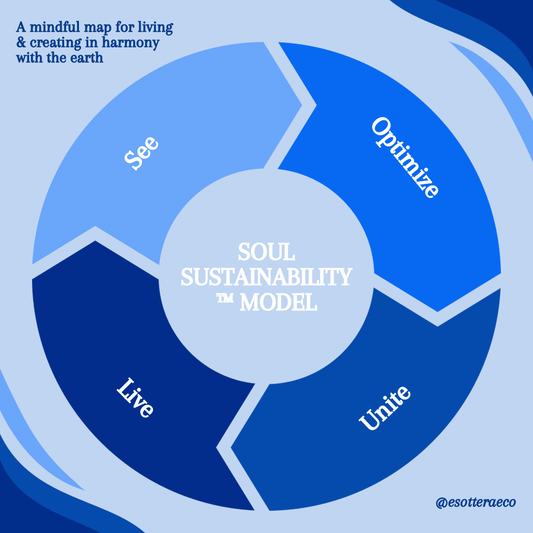
Regenerative living embodies multiple pillars of Esottera’s framework:
-
SEE™: Awareness of the impact of actions
-
OPTIMIZE™: Aligning personal and environmental systems in an efficient manner
-
UNITE™: Connecting with community, Earth, and emotional ecology
-
LIVE™: Expressing regenerative practices as identity and lifestyle
By living regeneratively, you move beyond obligation into joyful contribution. The inner and outer ecologies thrive together.
Measuring Regenerative Impact
Regeneration is measurable - both in ecological and personal terms:
-
Ecological: Carbon capture, biodiversity increase, soil health
-
Personal: Emotional resilience, energy levels, cognitive clarity
-
Behavioral: Frequency of sustainable actions, community engagement
Regular reflection on these metrics strengthens your regenerative habits and embeds sustainability as a lived experience.
The Ripple Effect of Regeneration
Regeneration creates a chain reaction:
-
One person’s restored garden → improved soil, air, and local pollinators
-
One calm, present individual → healthier interactions and mindful consumption
-
One community initiative → local ecological restoration
This mirrors ecosystems: small contributions amplify across networks.
Conclusion
Sustainability is necessary, but regeneration is transformative. It moves us from harm reduction to active renewal, from mindfulness to intentional action. Regenerative living restores the soil, the forest, the oceans - and ourselves.
Through Soul Sustainability™, Esottera invites you to integrate regenerative principles into your inner and outer worlds. Aligning yourself and your environment is not optional - it is the path toward abundance, resilience, and meaningful ecological impact.
References (APA)
Rodale Institute. (2014). Regenerative organic agriculture and climate change: A down-to-earth solution to global warming.
Seligman, M. E. P. (2011). Flourish: A visionary new understanding of happiness and well-being. Free Press.
Tang, Y.-Y., Hölzel, B. K., & Posner, M. I. (2015). The neuroscience of mindfulness meditation. Nature Reviews Neuroscience, 16(4), 213 - 225.