











































Soul Sustainability: The Future of Conscious Living
Sustainability has traditionally been discussed through a material lens - waste reduction, carbon footprints, energy efficiency. But as global ecological crises deepen, a new paradigm is emerging: Soul Sustainability - the recognition that our inner ecology shapes our outer impact.
What Is Soul Sustainability?
Soul sustainability is the practice of aligning internal states (emotion, attention, rhythm, consumption habits, and values) with external ecological wellbeing. It is grounded in the understanding that human consciousness and planetary health are interconnected systems, not separate domains.
Environmental psychologist Renee Lertzman (2015) describes this as “environmental melancholia” - the internal conflict people feel when they care about the Earth but struggle to act sustainably. This internal fragmentation leads to inaction, burnout, and emotional shutdown.
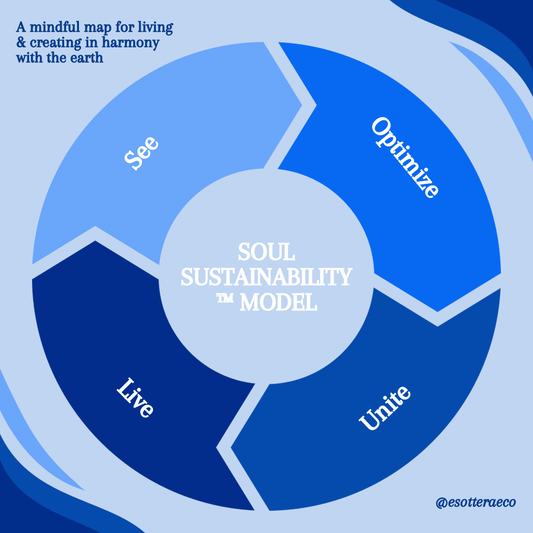
Soul sustainability repairs this fragmentation by:
-
Increasing awareness (SEE)
-
Realigning habits with values (OPTIMIZE)
-
Reconnecting with Earth’s rhythms and humanity (UNITE)
-
Embodying conscious action (LIVE)
Why Inner Ecology Matters
Research in behavioral science confirms that emotions, identity, and mindset are stronger predictors of sustainable behavior than information alone (Gifford & Chen, 2017). We don’t change because we “know better” - we change because we shift internally.
Practical Soul Sustainability Practices
-
Slow consumption
-
Rhythmic living aligned with daylight, seasons, and energy cycles
-
Grounding + nature-based contemplation
-
Nervous-system-aligned habit change
-
Emotional ecology work: feeling, processing, releasing
Soul sustainability is not “soft.” It is the missing root system of climate action.
When souls heal, ecosystems recover - and vice versa.
APA Sources
Gifford, R., & Chen, A. K. (2017). Why aren’t we taking action? Psychological barriers to climate-positive behavior. APA, 1-11.
Lertzman, R. (2015). Environmental melancholia: Psychoanalytic dimensions of engagement. Routledge.